


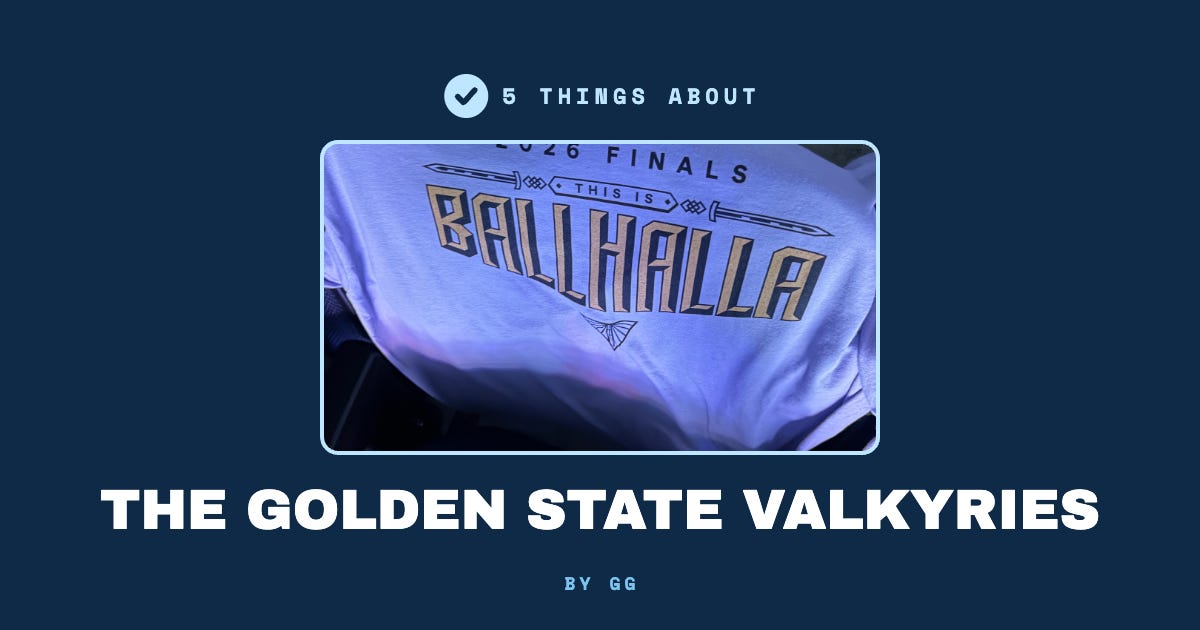
I wrote a little bit about why I created The Cool Check-In in my first post. That post is about wrestling, but there’s a nice little introduction about what this place might be like. Give it a look.
This post isn’t about wrestling. It’s about the Golden State Valkyries, and specifically, about why, in just a short two years, they’ve made my already crowded Bay Area sports viewing more crowded. And this year, they’ve become a higher priority than I could’ve imagined.
The Valkyries are currently up 3-2 against the Atlanta Dream in the WNBA Finals. This series isn’t pretty. It’s low-scoring, it’s free-throw heavy, and it’s guaranteed to go longer than any WNBA Finals in the 30-year existence of the league. Can the Valkyries pull it out and make history?
How did we get here?
1. The creation of Podhalla
My Valkyries fandom begins with Podhalla. My oldest son Brian and I co-hosted our old Golden State Warriors podcast called “The Death Lineup.” It’s not called that anymore, by the way. Why? Well, the Warriors aren’t imposing their will on others as much any longer.
But without that podcast, we wouldn’t have our growing-like-a-weed podcast on the Valkyries. Podhalla is an obvious pun on what the Valkyries call the Chase Center. Brian originally wanted to call the podcast Valks Valley. But when we spun it off officially, Podhalla was a better name choice, which Brian also came up with.
We wanted to cover the Valkyries from the beginning of their origin story. Imagine being able to cover the San Francisco 49ers in 1946, or the San Francisco Giants from the day they relocated to Northern California in 1958. That’s what we’re doing with the Valkyries.
The show gives us the opportunity to talk about the team, but also to learn more about women’s basketball. Last year, during the Valkyries’ inaugural season, I felt so uneducated about the WNBA. I tried to watch as much as I could to learn the nuances of the women’s game. This year, I feel much better, but I always joke that the day I’ll feel totally comfortable is the day that I compare a WNBA scenario with another WNBA scenario rather than an NBA scenario.
After learning a ton about what to do, as well as what not to do, in the WNBA podcasting space, Brian and I decided that we needed to expand the show. Our best decision was bringing in our favorite guest, Conrado Pascual, as a third co-host. Conrado has so much vigor for the game, and as a credentialed reporter for The Podium Finish, he adds an insider look-and-feel to the show.
Podhalla is now the most successful podcast I’ve created from the ground up. We have big plans for the off-season and even bigger plans for season three. Stay subscribed and tuned in.
2. Natalie Nakase, the basketball sicko
When the Valkyries chose Nakase to be the franchise’s first head coach, I, as a WNBA newbie, didn’t know much about her. I didn’t know her style of play, her basketball prowess, or what she wanted the team’s identity to be. But I did know that she was Japanese-American. I’m half Japanese myself. I don’t see too many Asian-Americans in leadership positions in pro sports. Erik Spoelstra, of the Miami Heat, and Dave Roberts, of the hated Los Angeles Dodgers, would be two of the most successful.
After watching her lead the Valkyries for two years now, and with the second of those two years landing the team in the WNBA Finals, one would think this is a nice little story for the 5-foot-2 former UCLA point guard. I’m not saying that Nakase’s story isn’t nice, just that it’s the story of a basketball sicko grinding through several stops in different countries to pursue a career that’s led her here. She coached in Germany and Japan and worked for the Los Angeles Clippers (which I’m sure isn’t quite like working for Joe Lacob) before landing under Becky Hammon in Las Vegas. She wasn’t a star player, but she’s a star coach with the mentality of someone who’s never had anything handed to her.
After telling her team to empty the tank game after game, she nearly emptied the tank herself by almost fainting on the sidelines in the second round of this year’s playoffs. I think she said she forgets to eat sometimes.
Some people reading may not understand why I mentioned Nakase’s Japanese heritage as an important highlight, but it’s because my hope is that in addition to leading the Valkyries to success, she also inspires Asians to follow in her footsteps and lead more pro sports teams.
3. A group of castoffs became a team
The inaugural Valkyries team leaned heavily on the expansion draft and international players.
On December 6, 2024, the Valkyries drafted the following players in the expansion draft:
Veronica Burton
Kayla Thornton
Kate Martin
Stephanie Talbot
Cecilia Zandalasini
Temi Fágbénlé
Monique Billings
Julie Vanloo
Carla Leite
Iliana Rupert
María Conde
The rules of that draft limited the Valkyries to drafting only one player per team, and the teams were able to keep their best six players, which meant that the players the Valkyries could select were, at best, the seventh-best player on each roster.
Three other players they signed that year, who are still on their current roster, were the following free agents:
Tiffany Hayes
Janelle Salaün
Laeticia Amihere
Their first ever draft pick was Justė Jocytė, who chose to not play in the WNBA in 2025. We’ll have more on her later. They also drafted Kaitlyn Chen in the third round. They waived her and then re-signed her that season.
Kaila Charles, now starting in the WNBA Finals, was closer to a journeywoman at 26 when she arrived.
Let’s just say that there were no sure-fire all-WNBA players on this team to start.
Let’s fast-forward to the 2026 additions. Their two big free-agent signings were Gabby Williams and Kiah Stokes. Williams was an All-Star in Seattle before joining the Valkyries. Stokes was on three WNBA championship teams in Las Vegas as a part-time starter. Stokes was signed to back up Rupert until Rupert was declared out for the season because of pregnancy.
Only three players on the current playoff roster have ever made an All-Star team. For most teams, the lack of star talent is a detriment. But in the case of the Valkyries, it has enabled Nakase to manage minutes in a way that hasn’t aggravated egos. That’s not to say players are egoless, because every player on this team was the best player on their high school team, and in some cases, their college or international teams. But because not every player expects a certain number of touches, or plays created for them, or is even depended on to do heavy lifting on the scoring end, it allows for the team to be coached and not necessarily catered to.
While I’m sure there are certain players who definitely believe they should be playing more, it hasn’t seemed to be an issue at all for the Valks and they are the true definition of a team. And pointing back to thing number 2, they have a coach whose previous basketball resume very much fits the players on the team.
4. Justė Jocytė the wunderkind
Before the very first WNBA Draft for the Valkyries, there didn’t seem to be a sure-fire draft pick. Even though they were the expansion team, they didn’t select until the fifth spot in the first round. The team who had to draft everyone’s bench wouldn’t have a shot at Paige Bueckers. Brian was very high on Dominique Malonga, but she would also not be around by the time that the Valkyries made their inaugural pick.
Former Bay Area standout from Stanford Kiki Iriafen was a possibility, but she was taken with the pick right before theirs. In an earlier mock draft, The Athletic’s Sabreena Merchant, who was a guest on our show before, talked about the possibility of the Valkyries drafting Lithuanian Justė Jocytė. Could the Valkyries afford to draft a player who might not come overseas in her drafted year?
Little did we know that the Valkyries would be known for the unconventional, especially when they punted their first-round pick this year completely.
But it was hard not to be excited about Jocytė. Brian went on Instagram and made some connections and lo and behold, he was able to secure an interview with her. As far as I know, Brian got her first podcast interview after she was drafted, and even if he didn’t, let’s pretend he did. And she was delightful. I loved it for Brian and I loved it for what eventually became Podhalla.
Earlier this summer, we got to meet her. Warriors World hosted an event in San Francisco and our Podhalla co-host Conrado Pascual was the MC and did a fantastic job interviewing Justė. She’s very charming and comes across as someone who has a quiet confidence in herself.
However, she has barely played during her rookie season. Rather than develop her during the season, the Valkyries’ brass decided that they had the team to win it all and they were going to lean on what was working. It’s hard to even critique Justė’s play because her minutes have been so inconsistent and in many games, not there at all.
Offensively, she looks like a gem. She plays like a veteran with the basketball in her hands and why shouldn’t she? She’s been a professional basketball player since 2019, when she was just 13 years of age. She’s been playing against women much older than her since she was a young teenager.
As I said above, I’m still a WNBA newbie and all my comparisons are NBA comparisons. But I think Justė would like this one. She reminds me of Chris Mullin. Most remember the Warriors great as a pure scorer and great shooter. And he was that. But an underrated part of his game was his passing ability. That’s Justė. She can shoot. But she’s an amazing passer.
As a quick aside, when we met her in San Francisco, I asked her if she knew Šarūnas Marčiulionis. He was the first Lithuanian player in the NBA and played locally for the Warriors. I don’t remember if she said she did, as it was a little loud in the pub, but then I realized that Marčiulionis retired from the NBA almost 10 years before Justė was born. Sheesh.
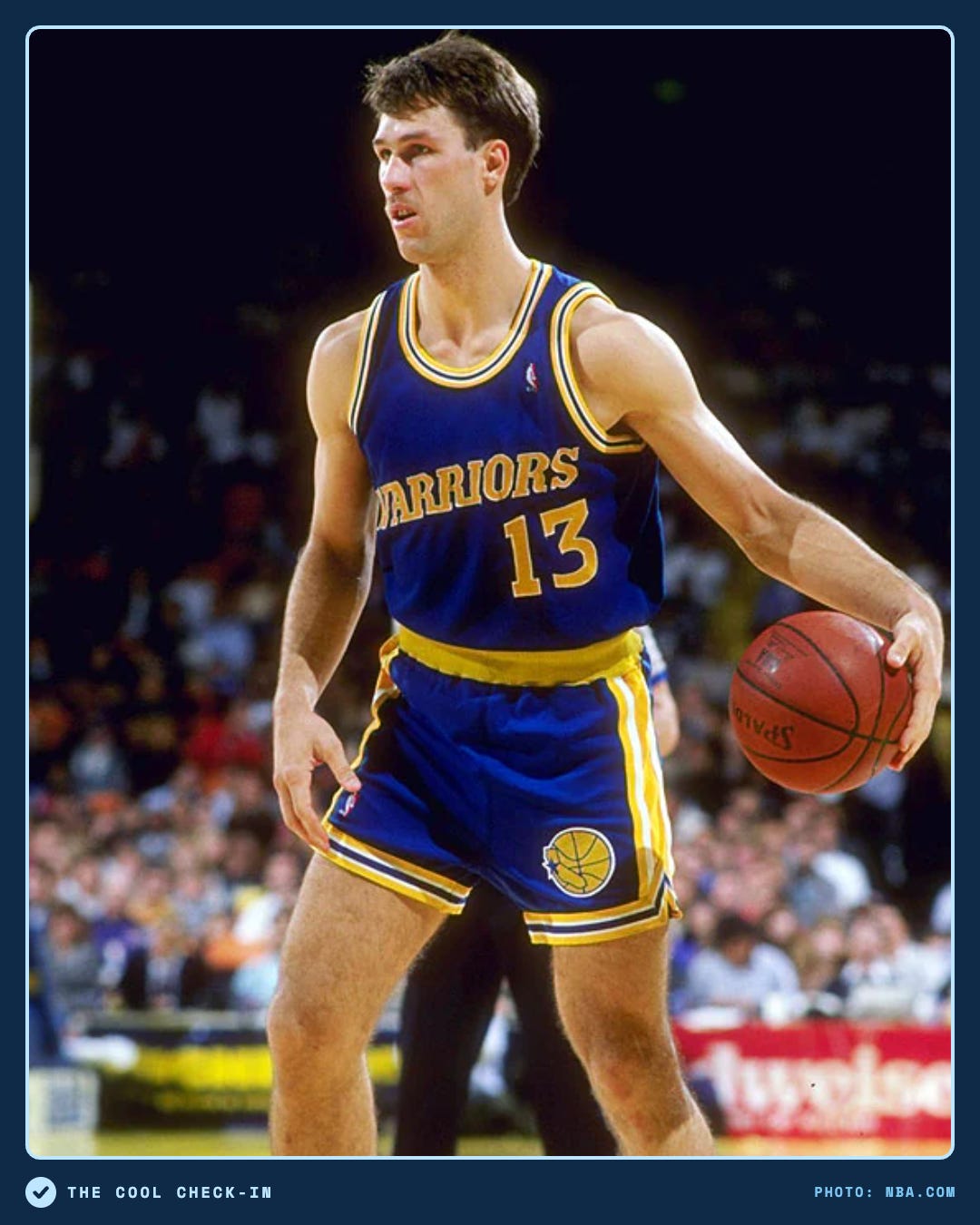
Going back to the idea that the Valkyries are a bunch of players who haven’t had it easy in the WNBA so far, it sort of makes sense that the wunderkind has to earn her stripes. And hopefully, she’s getting a WNBA education while she’s watching from the bench. She seems into it, even if you know she thinks she could be out there helping.
I think she’s going to be a valuable player next year. Like Conrado always says on Podhalla, no team ever brings back every player from the season before. There will be changes. And the Valkyries have a wunderkind who reminds me of Chris Mullin ready to knock down open jumpers and make passes that few players even try.
5. Ballhalla is an experience
Growing up in the Bay Area, I’ve been able to attend games at some very memorable ballparks, stadiums, and arenas.
Here’s a quick top eight of my favorite places to watch sports in person in the Bay Area:
Oracle Park (previously known as Pac Bell Park)
Oakland Arena (also known as Oracle Arena)
Chase Center (aka Ballhalla when the Valkyries play)
San Jose Arena (also known as SAP Center)
San Jose State Event Center (where the San Jose Lasers played)
Levi’s Stadium (if we were only choosing night games, Levi’s would be right behind Chase, but it’s awful on the wrong side of the stadium when the sun is out)
Candlestick Park (yes, it was our dump)
Oakland Coliseum (it wasn’t my dump, so it’s last)
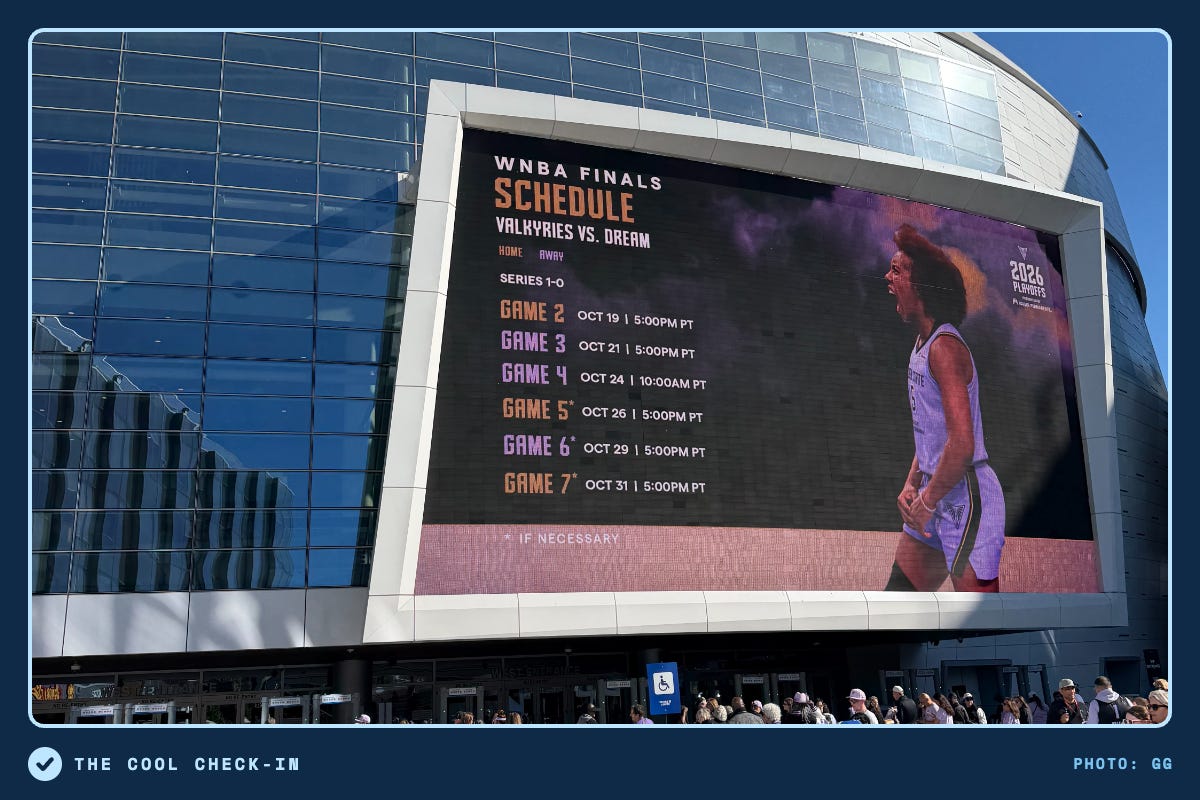
You’ll notice that Chase Center is third. The best NBA arena I’ve ever been to is Madison Square Garden. Chase isn’t MSG, but it’s very nice.
When the Warriors play, Chase is the place where all the rich tech folks sit in the front row and where folks who truly don’t care that much about whether the Warriors win or lose have the best seats. They might be there to see Steph Curry, but they’re also there because they can afford it.
When the Valkyries play, that place turns into a rave. Valkyries fans near and far, you owe it to yourself to make the trip to San Francisco to attend a Valkyries game in person. It’s everything advertised and more.
The Valkyries are on the precipice of winning the WNBA championship in just their second year of existence. The Atlanta Dream stand in their way. And of course, we’ll talk about it on Podhalla.